You can write the best article in your industry and have it reach no one. Not because it's bad — because the machines that decide who sees it couldn't read it properly. In 2026, content that isn't built for AI and search is content that goes dark.
Two audiences, one piece
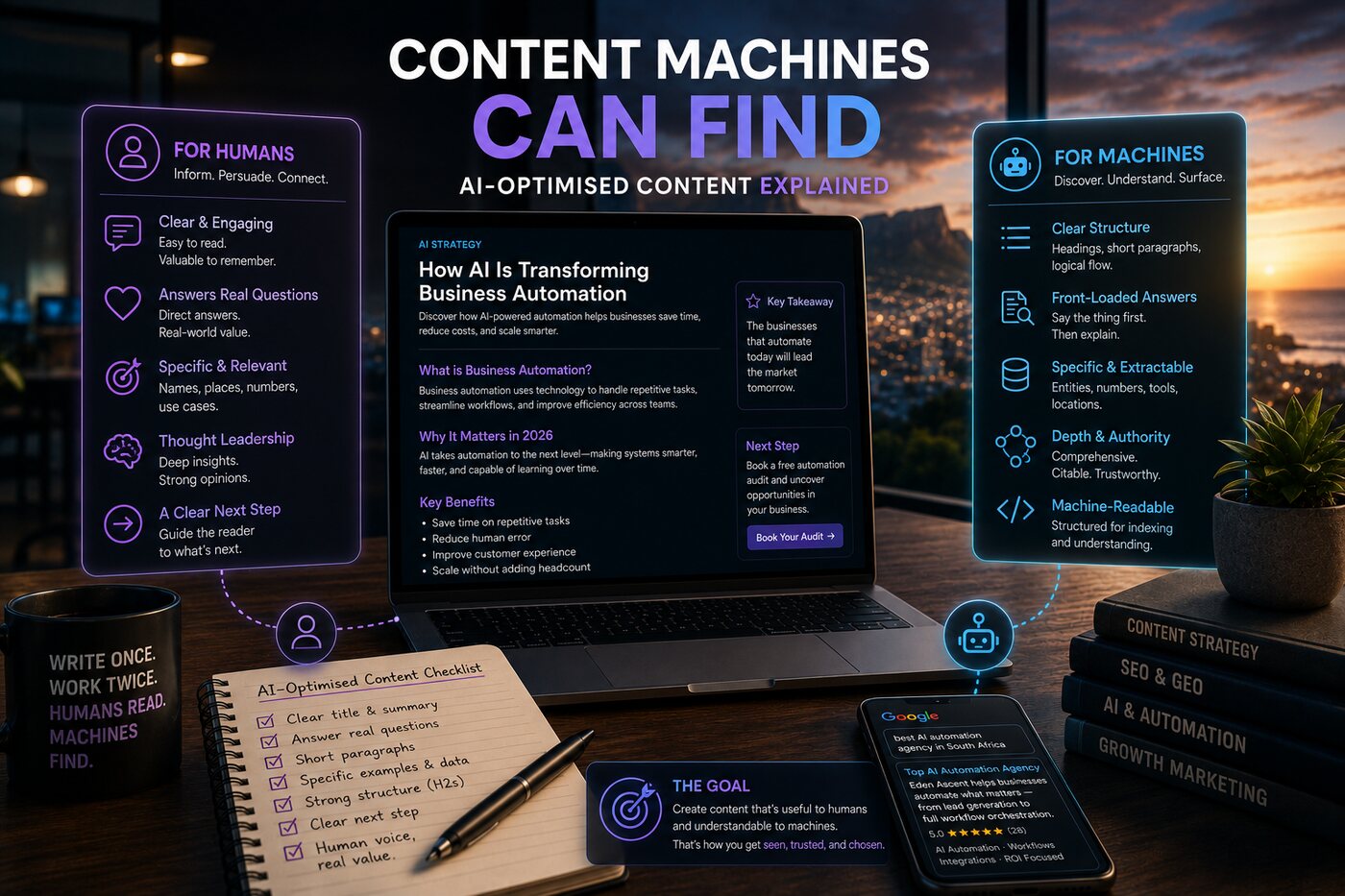
Every piece of content now has two readers: the human you're trying to persuade, and the machine deciding whether to surface you to that human. Write only for the human and the machine skips you. Write only for the machine and the human bounces. The craft is serving both in the same words.
What machines actually need
Clear structure. Headings that describe what follows. Short paragraphs. Real questions answered directly underneath them. This isn't dumbing down — it's making your expertise extractable. An answer engine lifts a clean, direct passage; it scrolls past a meandering wall.
Front-loaded answers. Say the thing, then explain it. Bury your conclusion in paragraph nine and the machine — and the reader — gives up at paragraph two.
Specificity and entities. Name the places, the tools, the numbers, the use cases. "We help businesses grow" tells a machine nothing. "We build GEO infrastructure for Western Cape staffing firms" gives it something concrete to index and recommend.
Genuine depth. Thin content fools no one anymore. Depth — a real, complete answer to a real question — is what earns citation. Aim to be the most useful page on your topic, not the longest.
The "AI-written slop" trap
Using AI to generate content and using AI-optimised content are not the same thing — and confusing them is costly. Floods of generic, machine-spun articles are exactly what search and AI engines are learning to ignore. The winning approach is the inverse: AI accelerates research and drafting, a human directs voice, judgement and truth, and the result reads like a brand with a pulse — not a template with a word count.
Structure that works
A reliable shape for AI-readable content: a sharp title that states the topic, a one-line summary of the payoff, H2 sections that each answer one clear question, short scannable paragraphs, concrete specifics throughout, and a closing next step. That's not a formula for blandness — it's a frame strong opinions and real expertise sit inside.
Content with a destination
Here's the discipline most content misses: every piece needs a next step. An article that informs and then dead-ends is publishing, not marketing. Point the reader somewhere — a deeper guide, an audit, a conversation. Content without a path to conversion is a cost centre wearing a thought-leadership costume.
Make every piece work twice: once for the human who reads it, once for the machine that decides who else gets to. That's the whole game now — and most of your competitors still haven't figured out they're playing it.