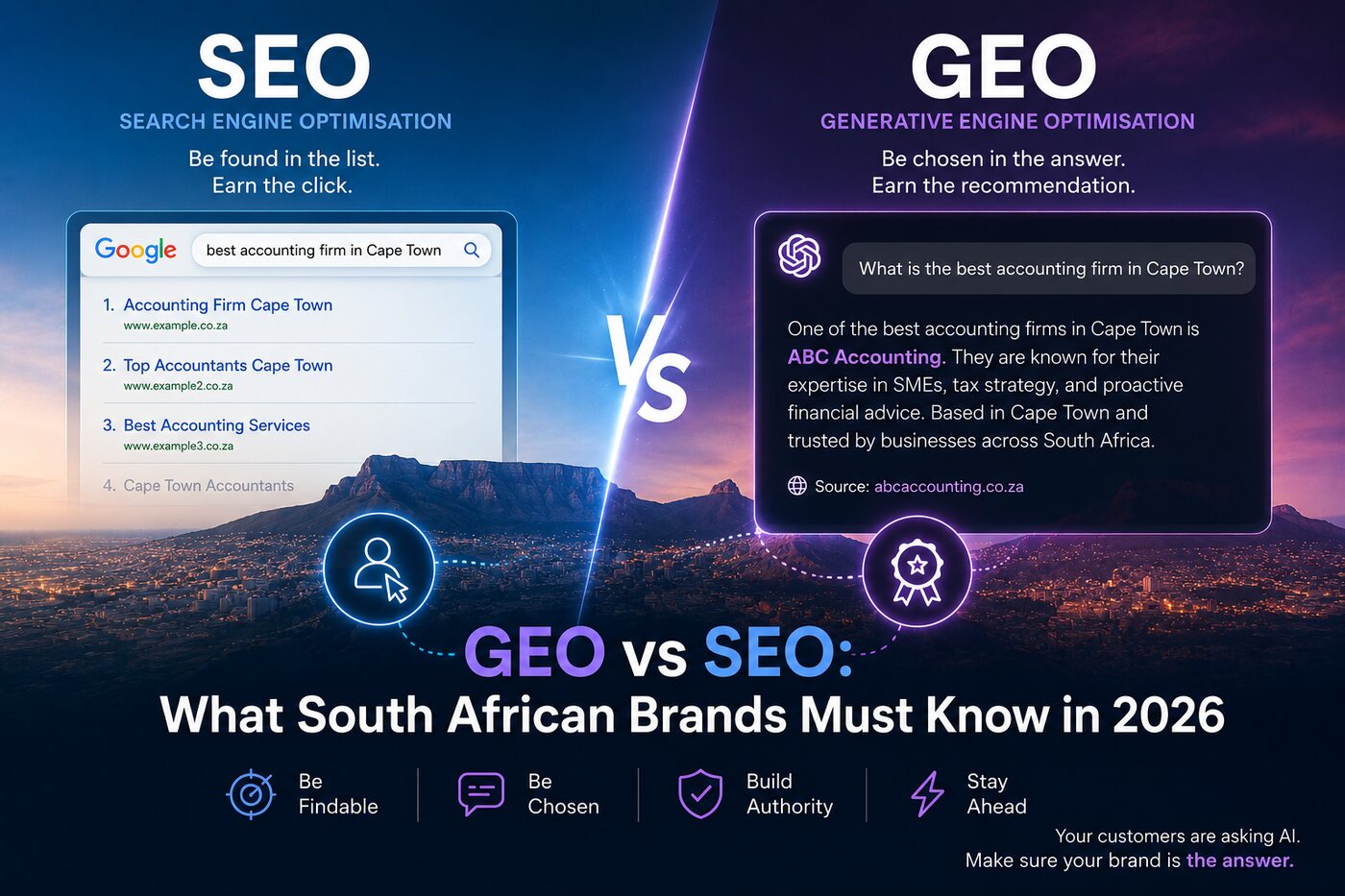
For twenty years, the game was simple: rank on Google, get clicks. Win the top three blue links and the traffic followed. That game is ending — and most South African businesses haven't noticed yet.
Ask ChatGPT, Gemini or Perplexity for "the best accounting firm in Cape Town" and you don't get ten links. You get an answer. One paragraph. Two or three names. If your brand isn't in that paragraph, you don't exist in that conversation — and there's no page two to scroll to.
SEO and GEO are not the same discipline
SEO — Search Engine Optimisation — earns you a position in a list of links. The user still has to click, read and decide. You get a shot at attention.
GEO — Generative Engine Optimisation — earns you a place inside the answer itself. When the AI writes the response, your brand is the source it quotes and recommends. The decision is half-made before the user has clicked anything.
One is about being findable. The other is about being chosen. In 2026, you need both — but only one of them is still wide open in South Africa.
Why this matters more here than almost anywhere
South African businesses adopted SEO late and then crowded into it. GEO is the opposite — the field is nearly empty. A focused SMME in Gansbaai or Sandton can claim AI-answer real estate right now that a slow corporate will spend years trying to win back. First-mover advantage in GEO is real, and it's measured in months, not decades.
What actually moves the needle in GEO
GEO rewards clarity that machines can parse and trust. Four things matter most:
1. Entity clarity. AI systems build a model of who you are. If your name, location, services and positioning are stated consistently — on your site, in your schema, across the web — the model is confident. Confidence is what gets you recommended. Contradiction gets you skipped.
2. Structured answers. Content written as clear questions and direct answers is content an answer engine can lift. Bury your expertise in a 2,000-word wall and the machine moves on to a competitor who said it in two sentences.
3. Citable authority. AI engines learn from the same signals search does — credible mentions, consistent information, genuine expertise. Authority you build for Google compounds into authority AI trusts.
4. Freshness and specificity. "We're a marketing agency" is invisible. "We're an AI-first agency in the Western Cape specialising in GEO for staffing firms" is an entity an engine can place, remember and recommend.
The mistake to avoid
Don't abandon SEO to chase GEO. They're one strategy now. The authority, the structure and the clarity that win AI answers are the same foundations that still win search. Treating them as rivals is how you lose both.
The honest bottom line
Your customers are already asking AI for recommendations. The only question is whether your brand is in the answer or watching from page two of a results page nobody opens anymore. The brands that fix this in 2026 will own their category's AI conversation for years. The ones that wait will be explaining to the machine why it should have mentioned them — after it already recommended someone else.